In the spaciousness of the summer holidays, I was grateful to have time to read, cover to cover – which can be a rarity for me – Paul Kingsnorth’s Against the Machine: On the Unmaking of Humanity.
It was an expansive and sobering read, although not without hope. Kingsnorth identifies himself as an Orthodox Christian and I had a sense of him challenging himself not to leave the reader bereft and despairing at the state of the world.
His central argument is that our societies have become increasingly hollowed out by what he calls ‘the Machine’: a vast technological and economic system that promises connection, convenience and progress while steadily uprooting us from many of the things that make us human.
Perhaps its most visible manifestation is our obsession with our ‘glowing screens’.
Look around the room at the start of almost any meeting and what do you see? Increasingly, it’s not people chatting to each other. It’s people looking down at their phones.
The Great Unsettling
Kingsnorth calls our current era ‘the Great Unsettling’.
For most of human history, cultures have been rooted. Those roots might have been in a particular place, a community, cultural traditions, a sense of lineage and ancestry, ceremonies of worship or initiation, the natural world or the divine.
By contrast, many of us now live remarkably unrooted lives.
We can work from anywhere, communicate with anyone and summon almost anything to our door. We might all have to live with the noise of drones making deliveries to our door, as residents of Texas are already doing (some of whom are fighting back against the 120 ‘drops’ that happen each day.) Yet for all this apparent connection, loneliness is widespread. We have more ways than ever to communicate but that doesn’t necessarily mean we are having more meaningful conversations.
As Kingsnorth writes, a rootless society is “a society with no sacred order: it is adrift, and open to capture by dangerous forces.”
His words reminded me of the French writer and ‘reluctant mystic’ Simone Weil, whom he quotes. Writing in The Need for Roots in 1943, she observed:
“To be rooted is perhaps the most important and least recognised need of the human soul.”
Kingsnorth identifies four things in which a human culture can put down roots: people, place, prayer and the past.
These four Ps feel increasingly significant in an age of AI.
What are we giving our attention to?
Recently, an FT article by Nadia Beard, ‘Want to resist the AI bros? Play the piano’, prompted me to reflect on how I spend my own time.
Beard describes leaving London to spend a year at a music conservatoire in Tbilisi. At 31, her career in journalism had crowded out her passion for playing the piano. Friends and family were mystified. She wasn’t planning to become a concert pianist, so what was the point?
The point, of course, was the experience itself.
The word ‘amateur’ comes from the Latin amare – to love. Similarly, Mihaly Csikszentmihalyi, whose research gave us the concept of ‘flow’, encouraged us to become ‘dilettantes’. The word has its roots in delectare: to delight in.
Both words point towards something we are in danger of losing: doing something not because it is productive, monetisable or useful, but because it brings us alive.
Flow arises when our attention becomes absorbed in what we are doing. The experience itself becomes the reward. We stop monitoring ourselves. Time recedes. We become more present.
This matters because how we spend our attention is how we spend our lives.
Reclaiming our attention
My own antidote to the Machine is often very simple.
I walk. And I talk.
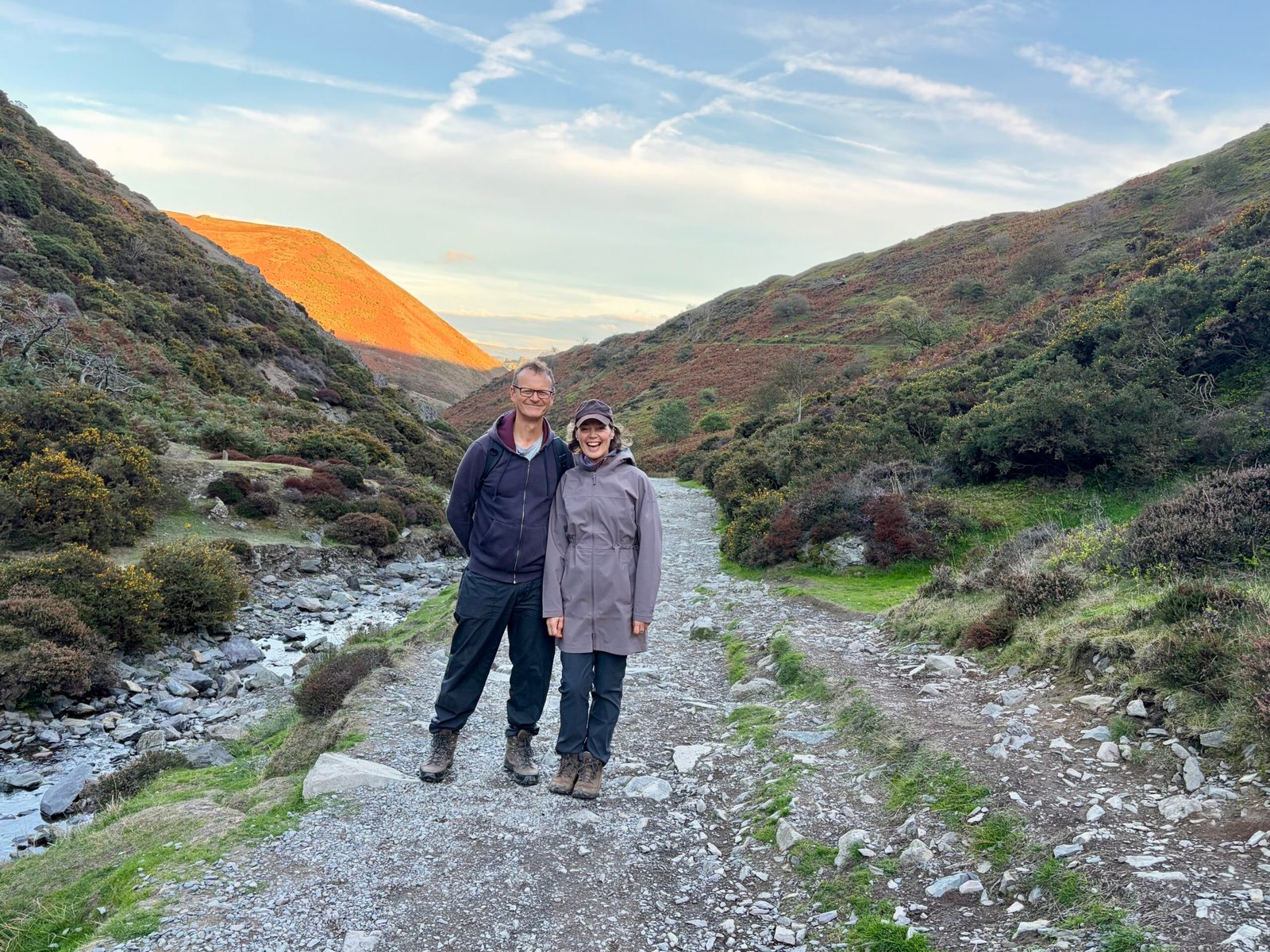
The photograph accompanying this blog was taken on the Long Mynd in the Shropshire Hills – my happy place. On this particular Sunday, I walked with my partner. We talked. We encountered another walker, Michelle, and talked with her too. There was no great outcome. Nothing was being optimised. Nothing needed to be produced.
Yet something important was happening.
Walking changes the quality of my attention. As the horizon widens, my mind becomes less cluttered. As my feet stop one in front of the other, I notice the changing light, the feel of the wind and the contours of the land. Conversation becomes more spacious too.
Perhaps this is one small way we begin the remaking of humanity.
Not through some grand initiative but from the roots upwards. We put our phones away. We go outside. We make something with our hands. We pray. We play music. We share a meal.
We look another person in the eye and ask a question to which we genuinely don’t know the answer.
Conversation as a root system
There is another kind of root that I would add to Kingsnorth’s four Ps: conversation.
Real conversation roots us in relationship.
When we give another person our undivided attention, something shifts. Instead of skimming across the surface of life, we become present to what is actually here. We listen not simply for the pause in which we can insert our own opinion, but to understand. We allow ourselves to be affected by another person.
This is the essence of dialogue.
At its best, conversation creates a space in which neither person knows exactly where they will end up. We become curious rather than certain. We slow down enough to notice our assumptions. We risk saying what matters. We listen for what might be trying to emerge between us.
This is not simply a communication skill. It is a profoundly human act.
Culture, after all, is not something abstract that exists ‘out there’. Culture is continually created through the countless interactions between us. It lives in how we greet a neighbour, respond to someone who disagrees with us, listen to a colleague, speak to our children or sit alongside someone who is struggling.
If we want a more human culture, we need more human conversations.
And that starts with the quality of our attention.
From the roots upwards
There is much about the trajectory of technology that we cannot individually control. AI will become more powerful. Algorithms will become more sophisticated at capturing our attention. Our screens are unlikely to become less compelling.
But we are not powerless. We can choose where we place our attention. We can choose what we practise. We can choose whether to fill every empty moment by reaching for a device or leave some space for our minds to wander.
We can choose whether a conversation is transactional or transformational. We can choose to become more rooted in people and place, in the natural world and whatever we experience as sacred.
My sense is that the remaking of humanity will not happen primarily through resisting technology. Nor does it require us to retreat from the modern world.
It asks something more subtle and perhaps more demanding of us: to become more fully human within it. To pay attention. To become present. To delight in what we love for its own sake. To have the conversations that matter.
Roots grow quietly. Much of their work happens underground, unseen. Yet they are what allow a tree to withstand the storm, reach towards the light and keep growing.
As Kingsnorth puts it: “rooted trees are hard to fell.”
Perhaps, in these unsettled times, growing roots is some of the most important work we can do.