That’s how President Trump described recent discussions with Iran. Yet there can be a striking tension. If one party claims “very good and productive conversations” with “major points of agreement” and the other party says no talks have happened at all and there’s no evidence of any significant change taking place, this brings up the question: what makes a conversation productive? Because clearly… it’s not just words.
What actually makes talking productive?
Research in psychology and education is unequivocal: Talk is not just a way of exchanging information – it’s how we think together. True dialogue must lead to change, not just conversation.
Only some talk leads to progress.
Neil Mercer calls this “Exploratory Talk” — the kind of dialogue where people don’t just talk… they ‘interthink.’ Writing in this month’s edition of The Psychologist, Mercer highlights in his article, ‘Is It only words?’, that productive conversations have distinctive qualities:
* Mutual participation – not one voice dominating
* Shared information – not selective disclosure
* Constructive challenge – disagreement without destruction
* Reason-giving – not assertion, but explanation
* Curiosity – checking understanding, asking questions
* Building on ideas – not talking past each other
* Movement toward agreement – even if partial
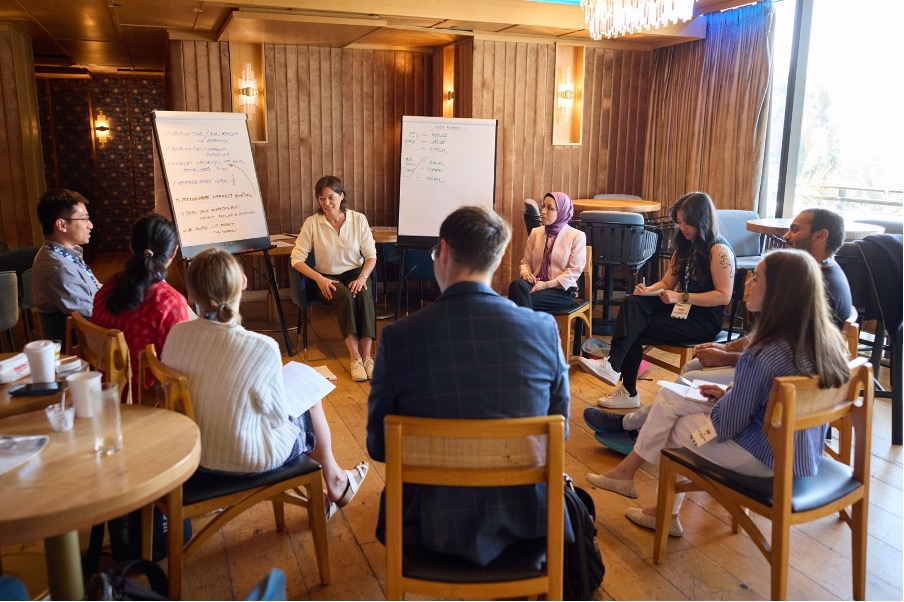
Photo credit: Schmidt Science Fellows, Los Angeles, 2025
If one side says “productive talks” and the other says “no talks”, we’re not seeing productive dialogue. We’re seeing a breakdown in shared reality.
And without shared reality, there is no collective thinking. Only parallel narratives.
Here then is a simple test for leaders. Before calling a conversation “productive,” ask:
* Did we understand each other — or just state positions?
* Did we change anything — or just repeat ourselves?
* Did we build something together — even a small step?
Because productivity in dialogue isn’t about optimism. It’s about building a shared understanding. It’s about a co-creation that changes something rather than talk going round in circles. It’s about leaving the room more lucid and more aligned even if full agreement hasn’t been reached.
In leadership — whether in a boardroom or on the world stage — talk becomes productive not when it sounds good, but when it creates new thinking between people.
That’s the real signal.
Everything else is… just words.