For good ideas and true innovation, you need human interaction, conflict, argument, debate. The mortar, not just the bricks.
Margaret Heffernan
For a collective to be a potent unit of productivity, it has to have good dialogue. In her 2015 TED talk ‘Forget the pecking order at work’, Heffernan challenges the ‘superchicken model’ of productivity – the idea that success comes from focusing solely on high-performing individuals. Instead, she argues that social cohesion is the true driver of high-achieving teams. To create this cohesion, leaders need to pay attention to the ‘mortar’ not just the ‘bricks.’
When it comes to strengthening the ‘mortar’ and cultivating collective intelligence, most meetings miss the mark. Recent research by Microsoft identified lousy meetings as the chief culprit of poor productivity, whether we’re in person or online. 58% of survey participants said it’s hard to effectively brainstorm in a virtual meeting. 55% said it’s hard to know what the next steps are once a meeting concludes. 56% said it’s difficult to summarize what happened.
Many managers and leaders see meetings as a menace and drain on their time. Two years ago, Shopify, the e-commerce company, hit the headlines for cancelling Wednesday meetings and those involving more than two people. In his 2025 annual letter to shareholders, Jamie Dimon, JPMorgan CEO, expressed his ire at poor communication and said to “kill” meetings that lack purpose or involve irrelevant people.
Why dialogue matters
Throwing out meetings, however, risks ditching access to collective intelligence. It’s not meetings per se that are the problem; it’s the lack of attention people pay in meetings that’s the killer. We all know how frustrating it is when someone is scrolling rather than listening, doing tiny typing instead of contributing or scanning emails instead of speaking. A dialogue will never deepen when our attention is fragmented. Our own state will never shine when we ‘split’ our focus.
In these turbulent, unsettling, game-changing times, dialogue is something that we cannot afford to be without. This is not easy territory, however. Dialogue is not polite conversation nor a cosy chat. It’s not panel-speak or performative listening. It’s not fractious debate or circular conversations that go nowhere.
Dialogue has a sense of ‘we’re in this together.’ It allows something new to emerge. We build a shared a shared understanding that leaves us feeling more lucid than before we talked. We arrive at a set of actions that everyone signs up to. And in so doing, we reinforce the ‘mortar’ that binds the collective together rather than splitting apart.
The question is, how does this happen? How do we have a conversation that gathers the intelligence in the room so that the whole is greater than the sum of parts? How does a dialogue turn into coordinated action?
How to cultivate collective intelligence
Have you ever noticed how the best meetings don’t feel rushed…but somehow get further?
At the end of a session, you’ll often find me at the flip chart, pen in hand, capturing what’s just emerged, after we’ve done some thinking together.
That’s the moment I’ve come to call ‘clutch’, inspired by athletes who coined the term. In sport, not all points are equal. At match point, tennis players flick the switch to go into a different gear when the stakes go up. Less ‘letting it happen’ and more ‘making it happen.’
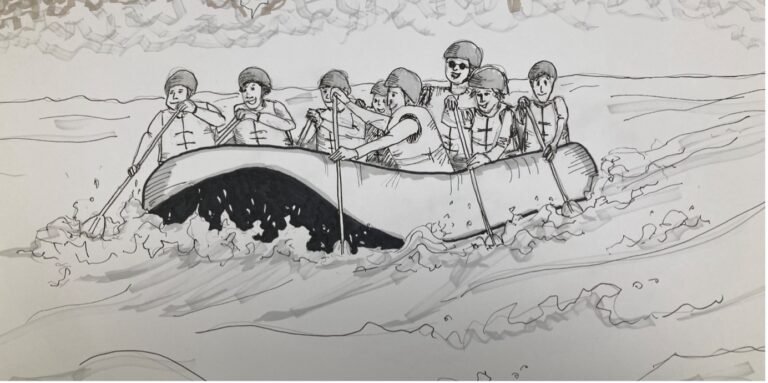
Most teams chase ‘flow’ — and rightly so. This is when attention locks in, ideas build, energy rises, and conversation moves fast. It’s dynamic and creative. You feel the group thinking as one. Researchers like Keith Sawyer, author of Group Genius, describe this as ‘group flow’ — a shared state of sync and mutual attunement.
But here’s what I see in almost every leadership team:
👉 Flow without clutch can become all-talk-and-no-action.
👉 Clutch without flow becomes analysis paralysis.
High-performing meetings need both.
Flow is expansion, fast thinking, generative dialogue, sparks flying between minds.
Clutch is compression, slowing down, sense-making, capturing what matters and deciding what to do.
It’s the gear change needed when driving uphill: you don’t stay in fifth gear and hope. You shift.
In practice, clutch looks like:
- Five minutes of silent reflection
- Writing before talking
- Summarising themes on a flip chart
- Asking, “What are we really saying here?” “What’s our decision?” “Who does what by when?”
Meetings need both flow and clutch
While flow creates the raw material, clutch hones it into something actionable. The best meetings have space for people to share ideas, exchange perspectives and see what’s emerging from sharing. When the room ‘gathers’, the energy is high, ideas are flying, and we feel ‘in sync’. Without a deliberate shift into ‘clutch’, people leave energised but unclear. Two days later, the momentum has quietly dissolved.
The slow-down to capture action points and shared insights isn’t a loss of pace — it’s where ownership happens. The decisions belong to the group. Actions are committed to. Things aren’t left hanging. Capturing decisions, surfacing themes, drafting a clear action plan in real time means that when people walk out of the room, there’s no ambiguity. Everyone knows what’s needed, who owns it, and by when. The collective intelligence that’s been generated then survives contact with the business-as-usual hurly burly.
Paradoxically , this “slow” phase is what makes teams faster later. Clarity beats speed. Decisions generate momentum. Agreed actions power a team forward.
In closing
Next time you design a meeting, don’t just ask: “How do we make this more engaging?”
Ask: “Where will we build flow — and where will we intentionally shift into clutch?”
That’s where insight lands. That’s where decisions stick. That’s where collective intelligence shows up.
And often… that’s the moment someone ends up at the flip chart, pen in hand, capturing the future.
References
Heffernan, Magaret. 2015. Forget the pecking order at work. TED talk https://www.ted.com/talks/margaret_heffernan_forget_the_pecking_order_at_work
McGuire, Tim. 2023. “Microsoft Study Finds Meeting Overload Is Real.” The Future of Commerce, May 17, 2023. https://www.the-future-of-commerce.com/2023/05/17/microsoft-study-meeting-overload/
Financial Times. 2025. “Why Jamie Dimon Is Right about Meetings.” Financial Times, April 19, 2025. https://www.ft.com/content/bd44a7d7-271f-4ff0-9ce5-62b64ea605be
Sawyer, Keith. 2007. Group Genius: The Creative Power of Collaboration. Basic Books