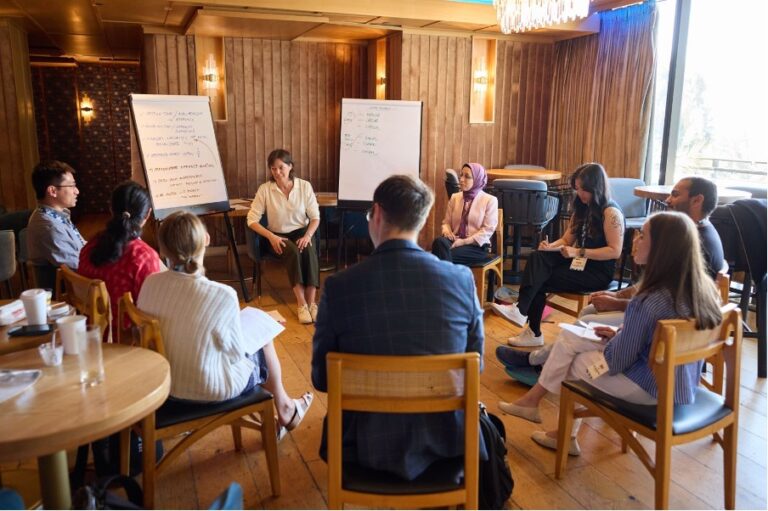
Imagine working in an organisation where everyone feels they are flourishing. The pace is steady not frenetic. Communication flows instead of an email blizzard. There’s time to talk and, more importantly, time to think, not just back-to-back meetings. If there’s an issue, people discuss it rather than going into silence or grievance. Before a challenging conversation, a leader takes a pause, finds some steady ground inside and then leans in. A little later – it might be a mere ten minutes – they feel a deep sense of calm as things move forward rather than staying stuck or festering further.
These possibilities are, I believe, well within our reach. We have inside us tremendous potential which remains, for the most part, untapped and under-acknowledged. As human beings, it is our birthright to feel energised and engaged and when we’re ‘in the zone’ together, the benefit to organizations is enormous. Individuals thrive, teams hum and a whole ecosystem of stakeholders lights up.
Whilst this scenario might sound like a fantasy, I see pockets of this potential being released in my work with start-ups, SMEs and global companies. Individuals who are able to focus their attention deliver value-adding work. Teams who are ‘in sync’ act with a collective intelligence greater than any individual could muster working alone. Organisations that invest in their people to lift productivity and wellbeing are more resilient.
In these stormy times, leadership is less about individuals pushing harder and becoming exhausted, and more about creating the conditions where we can think, feel and move forwards together. It is about creating flow. Experiencing flow as an individual and collective flow as a team is easier that we expect and makes a bigger impact than we realize, once we understand the obstacles that stand in the way.
What stops flow
One factor, in particular, drains the flow of energy from our organisations and zaps our ability to feel fully engaged and build collective insight. Distraction. Understanding how lack of attention diminishes dialogue and decision making generates insights about how to pivot in a different direction. Individuals feeling alive, teams becoming aligned and organisations achieving their ambitions are all possible when we find ways to manage distraction.
In the ‘infinite workday’ — a reality in which the average employee receives 117 emails a day and is interrupted every two minutes by a message, meeting, or notification – concentration becomes a key challenge. Nearly half of employees (48%) say their work feels chaotic and fragmented. The boundary between home and work has dissolved into a seamless, never-ending experience of “always on”[i].
The human cost is profound. One client, a senior partner in a professional services firm, told me, “I can’t remember the last time I did a piece of deep thinking. My days are just fragments stitched together by Teams links.” She laughed, but it wasn’t funny. When attention scatters, we stay stuck doing ‘shallow work’ that adds no real value. Fragmented attention creates a jumpy state of mind in which thinking clearly rarely happens. Feeling frazzled also cuts off at the pass the experience of ‘flow.’
Managing distraction
There are several behaviours that enable a group to cultivate their collective attention. These include having a shared goal, avoiding ‘rabbit holes’ and being able to re-direct a derailing conversation. When a group stays on topic, dialogue is dynamic and self-sustaining.
- Having a shared goal. When a group has a clear, common goal, even if the exact outcome is not fully defined, attention is directed rather than dispersed. When people are grappling with a shared challenge, a group can move beyond having serial monologues, fractious debates or circling discussions. The shared focus ‘pulls’ people’s attention, rather like a magnet ‘pulls’ iron filings into a coherent pattern, generating a magnetic field. People’s contributions are on topic and the ‘field’ of energy in the room becomes more coherent.
- Avoiding rabbit holes is essential for a dialogue to generate fresh insights. Diving into too much detail, getting sidetracked by juicy but irrelevant issues and getting lost in the weeds of a discussion all sap energy. A simple way to stay on track is to agree at the outset that anyone can – and must – flag if a conversation starts to go down a rabbit hole. When someone raises their hand to highlight this, it generally brings a sense of relief to the room. Others have often clocked it and they breathe more easily when it’s spoken out loud.
- Re-directing a derailing conversation can be as simple as saying, ‘let’s return to today’s main topic.’ It does, however, someone to have enough presence of mind to notice that the conversation needs re-focusing. Without this intervention, conversation circles, meanders or goes off the boil altogether. Having the goal written down and kept in view is a great ally. It also makes it easier to intervene as there is something concrete to point to. Dialogue is ‘a conversation with a centre not sides’ (William Isaacs) and reminding a group what’s central is a service to everyone.
- Dealing with devices. This isan on-going challenge for many groups. One team I worked with in the Middle East were so wedded to their devices that my co-facilitator created a ‘nursery’ for them. They had to drop off their smart phone at the start of the day, could check in with it at lunch time and collect it only when it was home time. With other groups I’ve contracted to allow the use of smart phones during a meeting when absolutely necessary as there are sometimes urgent demands. Tuning into the maturity of the group is essential so that you can decide together what will support attention staying in the room.
Becoming fully absorbed as a group generally doesn’t just happen – it calls for collective as well as individual ‘presence.’ This is the capacity to stay grounded, responsive and attentive in the moment, particularly when the stakes go up or plans go awry. Without presence, people are not available for dialogue and collective flow will never happen.
As Patrick Lencioni writes in his best-selling book, The Five Dysfunctions of a Team:
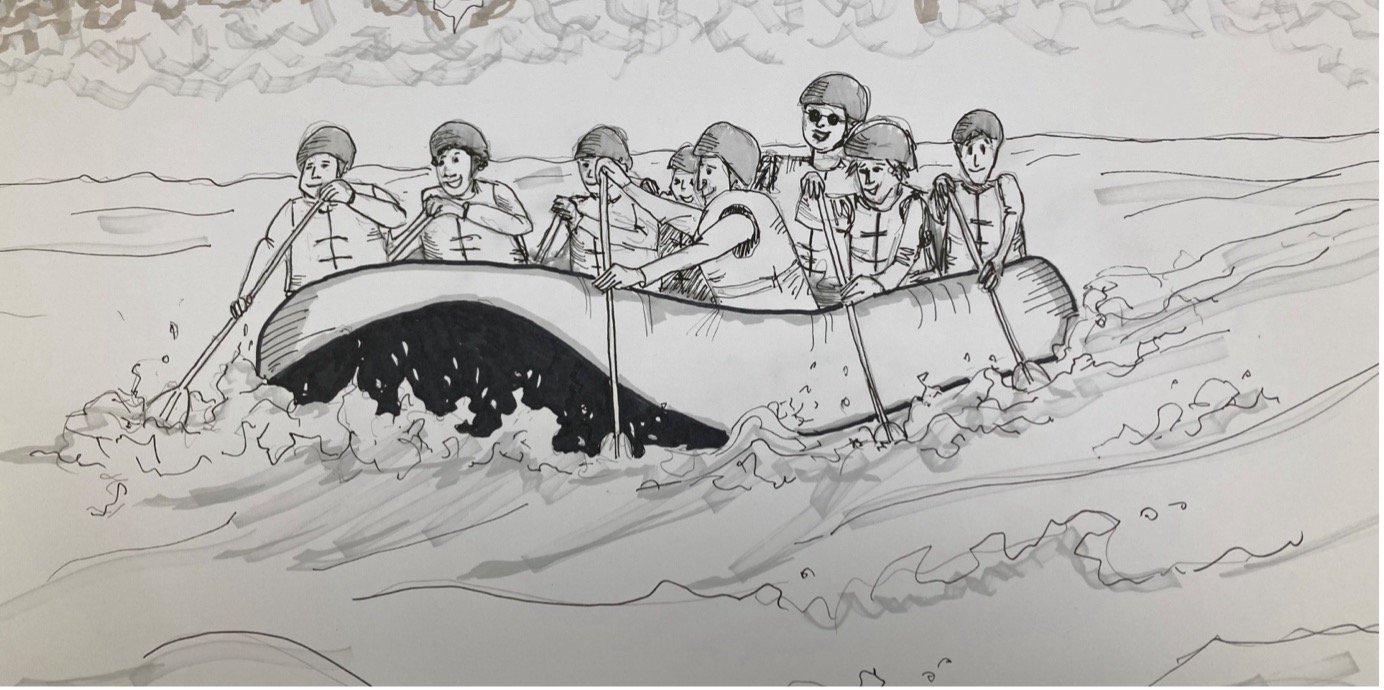
“If you could get all the people in an organization rowing in the same direction, you could dominate any industry, in any market, against any competition, at any time.“
Dialogue enables people to think (row) together. Collective flow (rowing in the same direction) is the lived experience that emerges (and feels fab.) Collective intelligence is the capability that results (and wins the race.)
References
Microsoft. Annual Work Trend Index 2025. Microsoft News Center, 2025. https://news.microsoft.com/annual-work-trend-index-2025/